Short answer
Georgia red clay is orange because it’s full of iron oxide, and its particles are extremely fine and chemically sticky. That combination means it bonds to porous surfaces such as carpet fibres, cloth seats, unsealed trim and wheel finishes, instead of resting on them. On paint it’s mostly an abrasion risk. On an interior it’s a genuine staining problem, and the fix is hot-water extraction, not a stronger cleaner.
Why clay behaves differently from ordinary dirt
Two things make North Georgia clay a special case.
The first is particle size. Clay particles are orders of magnitude smaller than sand or ordinary soil. They get into places dirt can’t: between carpet fibres, into the weave of cloth upholstery, into the texture of a plastic sill, into the pores of an unsealed wheel finish. A vacuum pulls out the sand sitting on top and leaves the clay behind.
The second is the iron. That orange is iron oxide, and it’s a pigment, from the same family of compounds used to colour paint. When wet clay dries in a carpet, the iron is deposited in and around the fibres and it behaves like a dye, not like a soil. Which is why scrubbing harder makes it worse: you drive it deeper and spread the halo.
The Cherokee County problem specifically
Everything here is under construction. Subdivisions off Bells Ferry, commercial build-out around Holly Springs, road work on the 575 corridor, new lots going in around Ball Ground and Hickory Flat. Grading exposes raw clay, and dry weather turns it into airborne dust that carries a long way from the site.
If you live on a street with a build going on, or your commute passes a graded lot, you’re getting a fine orange film on the car every dry day and a red spray up the sides every wet one. And if you have walked a job site, looked at a lot, or moved anything in the back of your vehicle, the clay is now inside it as well.
On paint: it’s an abrasion problem, not a stain
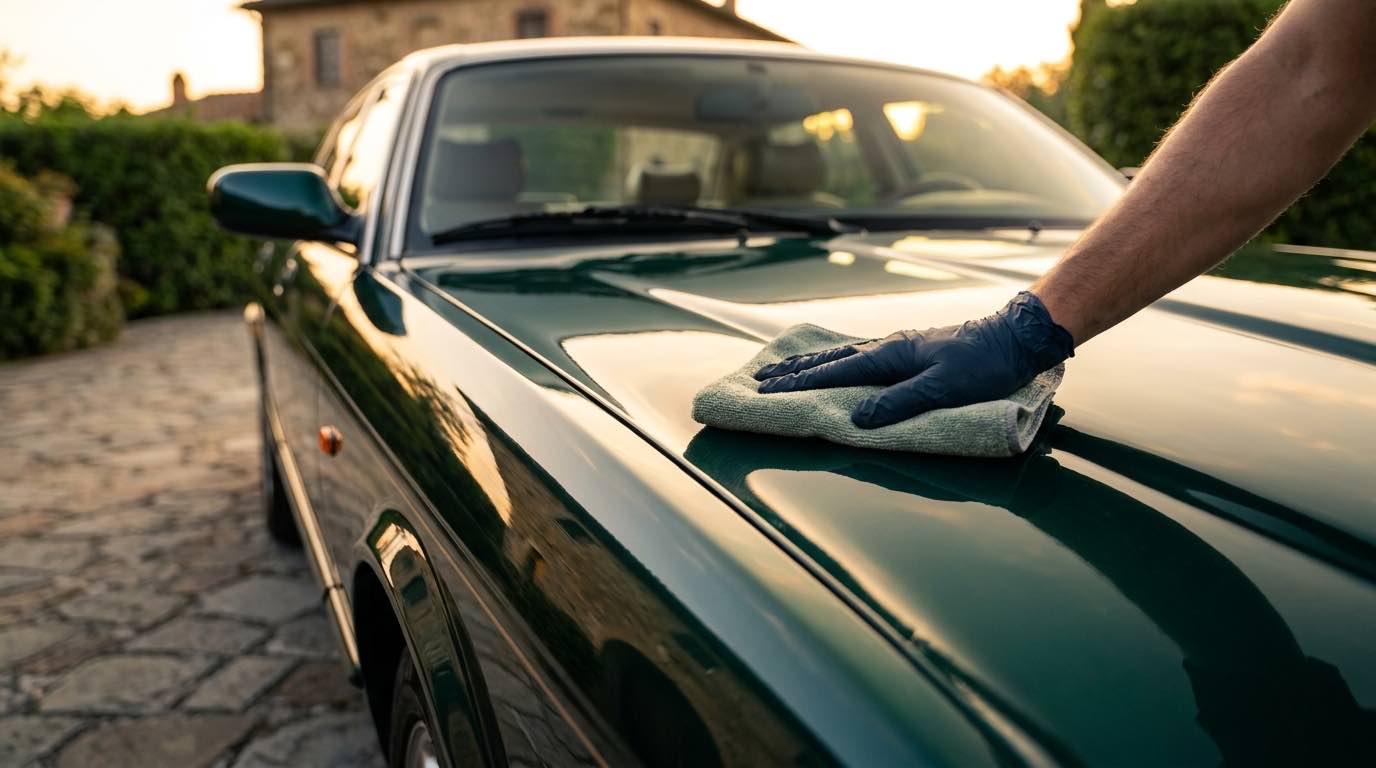
Good news first. Modern clear coat isn’t porous the way carpet is, so clay doesn’t stain healthy paint. What it does is sit there as a fine, hard, gritty film, and the moment anyone wipes a dusty panel that film becomes an abrasive.
The handling is the same discipline we preach for pollen: rinse thoroughly before anything touches the surface, then wash top-down with clean media. Never dust a clay-covered car dry.
Two places do need extra attention:
- Wheels and wheel wells. Clay packs into the barrel of the wheel and the liner, holds moisture against the metal, and stains any unsealed or damaged finish. This is where the orange actually sticks.
- The undercarriage. Caked clay traps water against the underbody and inside frame rails long after the car has dried. On a truck that spends time on unpaved lots this matters more than anything happening on the hood.
On an interior: this is the real damage
Carpet, floor mats and cloth seats are where clay wins. Here is what does and doesn’t work.
- Let it dry completely first. This is counter-intuitive and it’s the single most important step. Attacking wet clay pushes it into the backing and spreads the stain outward. Let it dry hard, then break it up and vacuum the loose material out.
- Vacuum properly, with agitation. A brush or a stiff drill brush lifts the fines out of the pile so the vacuum can take them. Suction alone barely touches embedded clay.
- Hot-water extraction is what actually removes the rest. A machine that injects hot solution into the fibre and immediately pulls it back out, carrying the suspended iron with it. This is the difference between a stain that fades and a stain that goes.
- Don’t over-wet it. Saturating a carpet with a shop-vac and a spray bottle drives the clay into the jute backing and, in Georgia humidity, gives you a mildew smell within a week. Extraction works because it removes as much water as it puts in.
- Rubber all-weather mats are the actual solution. Cheaper than repeated carpet extraction, and they take the abuse instead of the carpet.
We do this often enough in Cherokee County that we treat it as its own job. It’s the core of our Interior Detail, and it’s the service most likely to make someone say the car looks better than the day they bought it.
What about clay on light-coloured paint that won’t come off?
If you have washed the car and there’s still an orange tint low on the rockers or around the wheel arches, that’s usually not clay any more. It’s embedded iron: a mixture of clay-borne iron oxide and brake dust that has bonded into the finish.
That requires a chemical iron remover, which dissolves ferrous particles rather than scrubbing them, followed by a clay treatment for whatever is still stuck. It’s the same decontamination step a commuter car needs, and on a light-coloured vehicle out here it’s the step that gets the paint back to actually white instead of faintly rust-tinted.
A realistic maintenance answer
| Exterior wash | Every 1–2 weeks in dry spells, with a thorough pre-rinse and a wheel-well flush every time. |
|---|---|
| Wheels and wells | Every wash, with dedicated tools. This is where clay does lasting harm. |
| Interior extraction | Twice a year, or after any season of site visits. More if you have a truck bed and a job to do. |
| Iron decontamination | Annually on light-coloured vehicles, and any time the paint looks faintly orange after a proper wash. |
| Protection | Sealant or coating on paint and wheels. Clay releases from a slick surface far more easily. |
We bring the studio to the site
BlackLine Detail Company is fully mobile and self-contained, with our own water and our own power. We work driveways across Canton, Woodstock, Holly Springs and Ball Ground, and we’re used to vehicles that have earned their condition rather than neglected it.